
Implementation
Clinical trials are conducted in accordance with the trial protocol. Based on the eligibility criteria defined in the protocol, physicians select clinical trial candidates for participation. However, whether or not to participate in the clinical trial is the decision of the individuals selected by the physician.
How Are Clinical Trial Participants Selected?
The clinical trial protocol defines eligibility criteria for participation. Potential participants may be introduced to the clinical trial by a physician or may discover the information on their own.
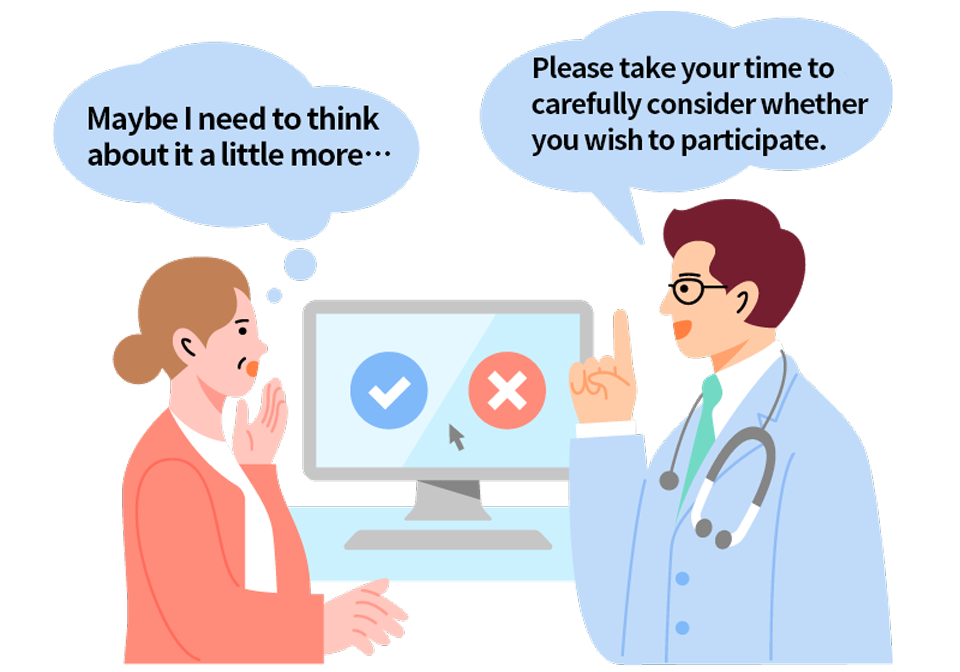
In either case, the physician provides a thorough explanation of the clinical trial to those who may qualify, and obtains their written consent. Even after receiving an explanation from a physician or medical staff, participation in the clinical trial is entirely voluntary. In other words, after receiving an explanation from the physician, individuals can decline for any reason.
After written consent is obtained, health tests are conducted as specified in the protocol to confirm whether the participant is suitable for the clinical trial.
Why Are Eligibility Criteria Set for Participants?
Eligibility criteria are set to protect clinical trial participants. If a person has another illness or is taking other medications, there may be a higher risk of side effects from the candidate drug. For example, even if it is effective for a certain condition, if a candidate drug causes the adverse reaction of raising blood pressure, patients with hypertension may be excluded from participating.
Eligibility standards also help ensure the proper evaluation of the drug candidate’s safety and efficacy.
What Rights and Support Systems Are Available for Clinical Trial Participants?
Participating in a clinical trial may involve both benefits and risks. Therefore, participants are entitled to a range of rights and support systems.
Examples of rights and support systems:
- The right to withdraw from the clinical trial at any time and for any reason
- Reimbursement to help reduce the burden of participation in the clinical trial
- Testing costs during the investigational drug period are covered by the pharmaceutical company
- If adverse reactions occur, the participant can receive compensation from the pharmaceutical company
*Compensation is subject to certain conditions
*For more details, refer to the clinical trial videos “Participation and Withdrawal” and “In Case of Health Damage.”
[Link to clinical trial explanation video]

Roles of People Involved in Clinical Trial Implementation
During the course of a clinical trial, patients, medical institutions, the MHLW, and pharmaceutical companies each have distinct roles. Each has its own role, and the clinical trial is conducted through collaboration. This way, accurate data on the candidate drug can be gathered.
Click here for Chugai Pharmaceutical's philosophy on “Collaborating with Patients in Drug Development”
Understand the contents of the Informed Consent Form, attend scheduled visits, undergo testing, and use the candidate drug as instructed. Additionally, report any changes in health condition to the attending physician.

Conduct the clinical trial as planned, conduct assessment of safety, and evaluate the candidate drug’s efficacy and safety. Institutions also report clinical trial progress to the Institutional Review Board (IRB) and undergo review for continuation.

Upon receiving new information or protocol amendments related to the candidate drug from the sponsor, the MHLW reviews the changes and may issue instructions such as discontinuation of the clinical trial, protocol revisions, or additional testing, as necessary.

Pharmaceutical companies continuously monitor to ensure that the rights and safety of participants are protected and that the clinical trial is conducted in accordance with the protocol and GCP guidelines.

What Responsibilities Do Medical Institutions Have During a Clinical Trial?
Under the leadership of the physician leading the clinical trial, medical institutions provide explanations to participants, monitor their safety, and evaluate the candidate drug. If any adverse reactions occur, appropriate treatment is administered. Clinical Research Coordinators (CRCs) work alongside physicians, nurses, pharmacists, medical institution staff, and the sponsor to ensure the smooth operation of the clinical trial.
What Responsibilities Do Pharmaceutical Companies Have During a Clinical Trial?
Sponsor representatives confirm that participants’ rights are protected, that the clinical trial is being conducted properly, and that there are no adverse reactions. They may review medical records directly or meet with staff at medical institutions. They are also responsible for reporting updated information to the medical institutions and the MHLW.