
Review
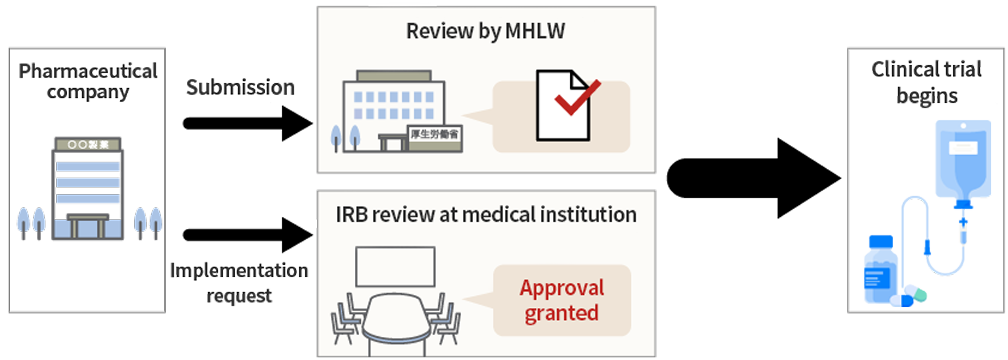
Clinical trials are conducted only after undergoing review by the Ministry of Health, Labour and Welfare (MHLW) and the Institutional Review Board*1 (IRB) designated by the medical institution.
What Reviews Are Required to Start a Clinical Trial?
Based on the submission from the pharmaceutical company, the MHLW reviews whether the trial complies with applicable regulations. The medical institution consults the IRB*1 to determine whether the clinical trial can proceed and makes a final decision based on the IRB's findings.
What Does the Ministry of Health, Labour and Welfare Review?
Before a trial begins, the MHLW reviews the clinical trial protocol to ensure it complies with GCP and other regulations, that participants' rights and safety are protected, and that the trial is scientifically valid. If necessary, the MHLW may request modifications, requiring the pharmaceutical company to revise the protocol.
Through these reviews, the MHLW also tracks which candidate drugs are being tested and at which medical institutions.

How Do Medical Institutions Review the Trial?
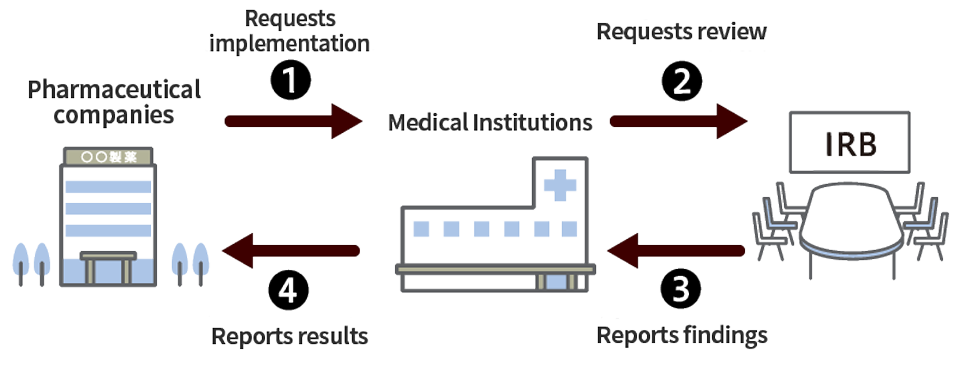
First, the pharmaceutical company requests a clinical trial to be conducted at a medical institution that it deems to have adequate facilities and staff. The institution then asks its Institutional Review Board (IRB)*1 to review whether the clinical trial can be conducted and makes a final decision based on the IRB’s evaluation.
What Does the Institutional Review Board (IRB) Review?
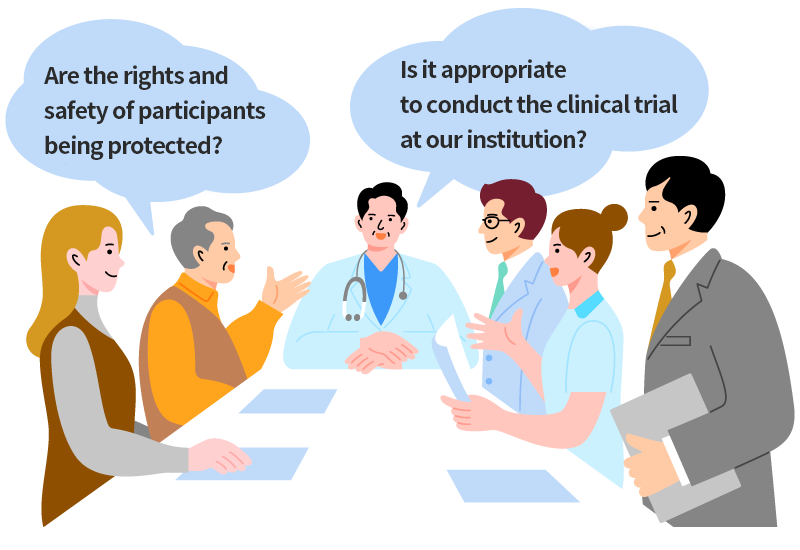
The IRB reviews whether it is appropriate to conduct the clinical trial, whether it is ethically and scientifically safe for participants, whether there are any disadvantages, and whether the trial should be conducted at the given institution. Review documents include the clinical trial protocol and the information leaflet materials for participants.
Who Serves on the Institutional Review Board (IRB)?
The IRB includes physicians, nurses, and pharmacists with medical expertise, as well as lawyers and members of the general public, to ensure objective reviews from multiple perspectives. To maintain neutrality, individuals directly involved in the clinical trial—such as the director of the institution, trial physician, or Clinical Research Coordinator (CRC)*2—are not allowed to participate.
 Terminology Explanations
-
*1 Institutional Review Board (IRB):
A committee that reviews whether clinical trials protect the rights and safety of participants and meet scientific and ethical standards. According to GCP, an IRB must include medical professionals, as well as non-affiliated members and individuals without a medical or pharmaceutical background.
-
*2 Clinical Research Coordinator (CRC):
A staff member who supports the operation of clinical trials. CRCs assist both patients (clinical trial participants) and physicians, and also coordinate with pharmaceutical companies to help ensure smooth trial operations.
You are now moving to an external website.