Increasing Product Reliability
The Chugai Group works hard to supply high-quality medicines and pharmaceuticals, and to ensure patients and healthcare providers use its products properly by offering timely and accurate delivery of quality information.
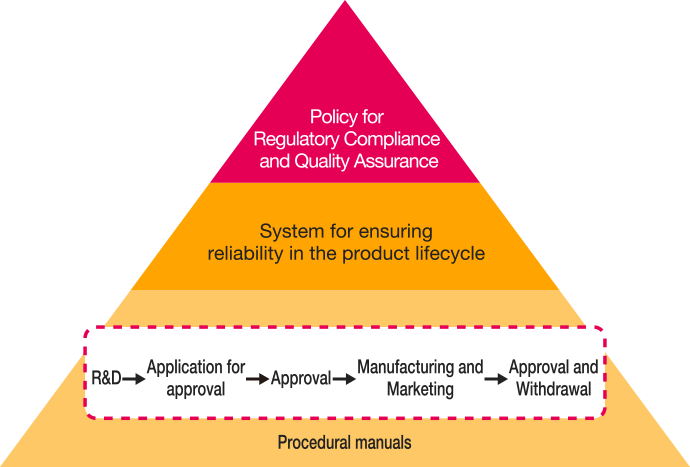
Policy for Regulatory Compliance and Quality Assurance
The Chugai Group basic approach is set forth in the policy for regulatory compliance and quality assurance.
The policy for regulatory compliance and quality assurance places specific emphasis on the following four points (four qualities).
- Product quality
- Product information quality
- Business process quality
- Staff suitability
To provide high-quality products and information, the Chugai Group believes it is important to ensure the quality of the business processes that generate them, and to secure suitable personnel to actually perform that work.
System for Ensuring Reliability in the Product Lifecycle
To provide patients and healthcare workers with products of superior efficacy and safety, the Chugai Group engages in a continuous effort to ensure reliability across the product lifecycle, from R&D to application for approval, manufacturing and marketing, and approval withdrawal.
System for Ensuring Reliability in the Product Lifecycle
Activities to Foster a Culture of Quality
The Chugai Group believes in the importance of an organizational culture that pursues quality by initiating its own improvements in processes and rules. To continue to provide high-quality products, we are engaged in a number of activities designed to foster a culture of quality. We continue to build awareness through dialogue, encouraging our employees to think about what quality means to them and what matters most in improving quality, and ensuring that each of them is able to take independent action.
What Developing Quality Awareness Means
![A diagram showing Chugai’s framework for Conditions that foster an awareness of quality: [Mindset and Attitude] Patients are always put first. Everyone always acts after considering “Why?” rather than following set procedures without question. Everyone takes an interest in quality and works autonomously to continually improve quality. [Communication] Necessary information is conveyed to the right individuals, irrespective of organization or seniority. People speak up without hesitation or fear. Previous mistakes and lessons learned are passed on. [Employee Ownership] All employees see quality as their personal responsibility. All employees work together to meet common quality objectives. [Leadership] Executives and management communicate the importance of quality through quality objectives and a vision. Executives and management take the initiative and set an example for others. Executives and management give credit and support for decisions and actions to improve quality.](/english/sustainability/patient/reliability/images/pic_csr_patient09_2020.png)
Responding to Inquiries at the Medical Information Department
Recent advances in science and technology have led to the development of many innovative medicines and treatment approaches. Ensuring that patients who need these therapies have access to them in a timely manner is a critical priority. To achieve this, it is essential that both healthcare providers and patients actively engage in shared decision-making. At the same time, pharmaceutical companies are increasingly expected to provide clear and accessible information on the quality, efficacy, and safety of their products to support the appropriate use of medicines.
Medical Information Department in the Chugai Group responds to inquiries from patients, their families, and healthcare providers via telephone, email, website contact forms, and various other channels. By leveraging the global resources of the Roche Group, we provide highly specialized and globally consistent information.
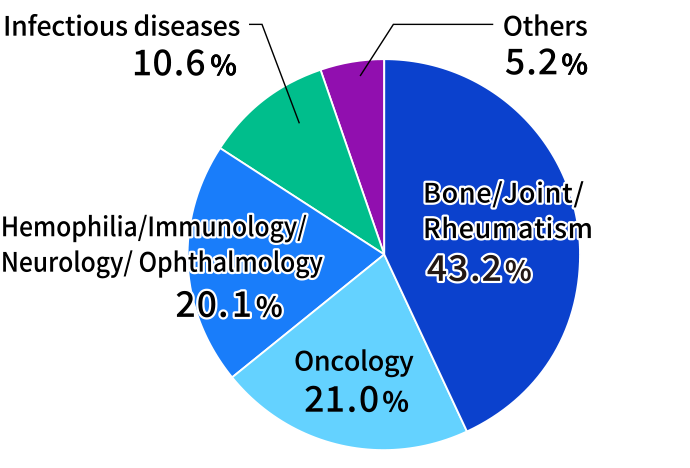
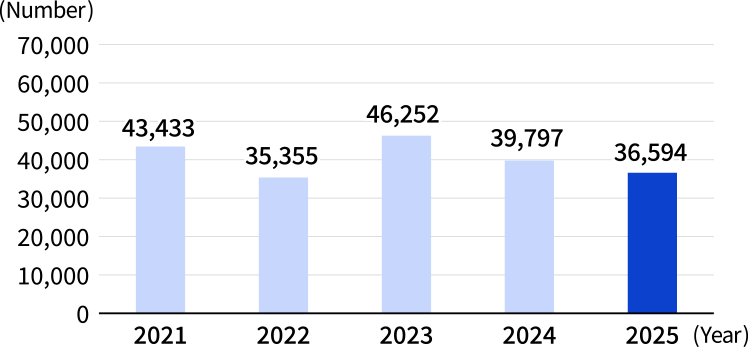
In recent years, the widespread adoption of search services, including AI-powered tools, has diversified the ways in which people access pharmaceutical information. As a result, shifts have been observed in the number of inquiries received through telephone and other channels, as well as in website traffic. In 2025, the Medical Information Department received approximately 36,000 inquiries via telephone, email, and other channels, a decrease of approximately 3,000 from the previous year. Approximately 70% of inquiries came from pharmacists. By therapeutic area, inquiries were particularly frequent regarding humanized anti-human IL-6 receptor monoclonal antibody preparations, influenza medications, osteoporosis treatments, and anticancer agents. The website for healthcare professionals addresses inquiries through the Product Q&As, while Web FAQs are available on the website for patients. In 2025, the Product Q&As on the website for healthcare professionals were accessed by approximately 100,000 unique visitors, and Web FAQs on the website for patients were accessed by approximately 93,000 unique visitors.
Our team remains committed to a patient-centered approach, working collaboratively to continually enhance the quality of our services and the overall experience for our customers.
Number of Inquiries Received
Inquiries by Disease Area