
Initiatives to Reduce Environmental Impact in the Shipment of Biopharmaceutical Drug Substances
The Chugai Group considers global environmental conservation to be a critical foundation supporting all business activities and is advancing initiatives to reduce environmental impact at every stage of its operations, including research, manufacturing, and shipment of pharmaceuticals. As part of these efforts, we have developed a new shipment container for the shipment of active pharmaceutical ingredients (biopharmaceutical drug substances), which are a key feature of its portfolio, with the aim of reducing CO2 emissions in the pharmaceutical cold chain that maintains low-temperature conditions from manufacturing sites to final destinations.
Pharmaceutical Cold Chain and Environmental Considerations
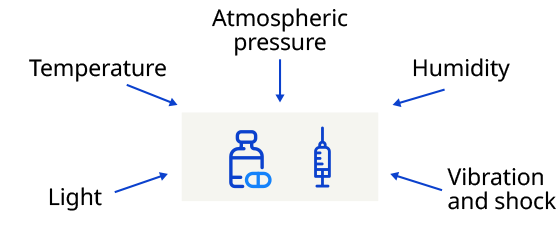
The most important priority in pharmaceutical shipment is delivering high-quality medications to patients. Therefore, it is necessary to protect pharmaceutical quality against environmental factors such as temperature, humidity, vibration, and shock that occur during shipment.
-
Examples of environmental factors affecting quality
-
Examples of quality deterioration
Target Examples of quality deterioration Drug substances Protein denaturation and aggregation
Changes in properties due to chemical reactionsDrug formation Degradation of active pharmaceutical ingredients (decrease in content, formation of impurities)
Tablet cracking/chipping
Vial/syringe breakagePackaging Packaging damage/deterioration
Abrasion of printing and labeling
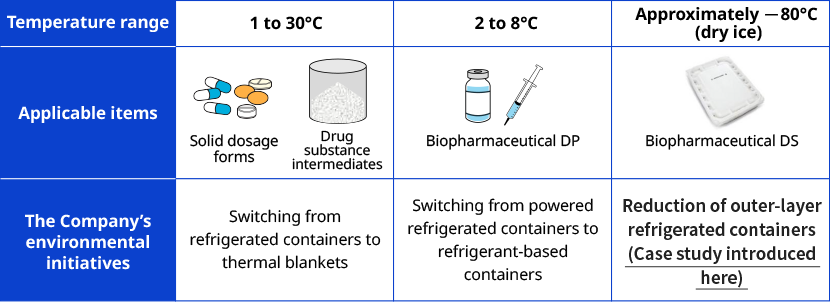
The main items subject to shipment in pharmaceutical logistics, their required temperature ranges, and the Company’s environmental initiatives are shown in the figure below. In particular, biopharmaceuticals are prone to quality deterioration if temperatures exceed certain thresholds during shipment, making it essential to maintain a low-temperature environment.
Meanwhile, from an environmental perspective, challenges include increased energy consumption for cooling required to maintain the pharmaceutical cold chain and increased CO2 emissions during shipment due to the overall weight of containers.
Environmental Challenges in Biopharmaceutical Drug Substance Shipment
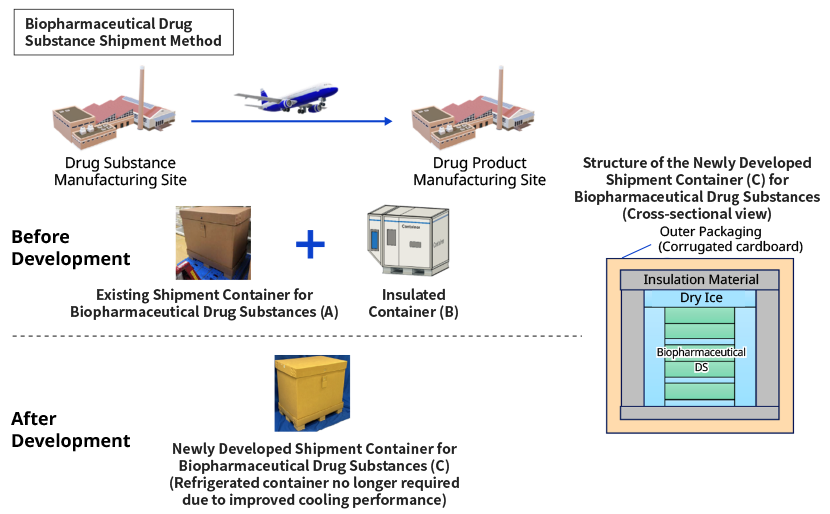
In conventional overseas shipment, as shown in the “Biopharmaceutical Drug Substance Shipment Method” in the figure below, biopharmaceutical drug substances were shipped by placing dry ice in a dedicated shipment container (A), which was then housed in a refrigerated outer layer container (B) to ensure the low-temperature environment required for quality maintenance. While this method ensured quality maintenance, it also increased the overall container weight, leading to higher energy consumption during shipment and increased CO2 emissions.
Concept for Development of the New Shipment Container
To address these challenges, the Chugai Group focused on the cooling performance of the shipment container itself for biopharmaceutical drug substances. By optimizing the placement and amount of dry ice as well as the specifications of the insulation materials, we successfully developed a new shipment container (C) that can maintain the required low-temperature environment without the need for the refrigerated outer layer container (B), as shown in the figure “Biopharmaceutical Drug Substance Shipment Method.”
This container uses an integrated structure combining a cardboard outer casing, insulation materials, dry ice, and biopharmaceutical drug substances, thereby ensuring cooling performance during shipment while simplifying the container configuration and reducing weight.
Environmental and Economic Effects
The introduction of the new shipment container is expected to reduce CO2 emissions associated with shipment by approximately 40% compared to conventional methods. Cumulatively from 2026 to 2035, CO2 emission reductions of approximately 401 tons are expected based on ton-kilometer calculations and projected shipment volumes, contributing to the Chugai Group’s medium-term environmental target of “reducing Scope 3 emissions by 30% by 2030.”
In addition, eliminating the need for refrigerated outer layer containers leads to reduced shipment costs, achieving both environmental impact reduction and economic efficiency.
Contribution to Sustainability
This initiative embodies the Chugai Group’s approach of prioritizing pharmaceutical quality while simultaneously pursuing reductions in environmental impact. Similar to the introduction of environmentally friendly materials in product packaging, we aim to improve resource efficiency through technological innovation in the shipment domain and create environmental value across the entire supply chain.
The Chugai Group positions sustainability at the core of its business activities and has adopted “creating shared value” as a fundamental management policy, aiming to simultaneously enhance corporate value and create social value through the resolution of social issues. We will continue to strengthen our research and development capabilities and contribute to the realization of a sustainable society through the creation of environmental value across the entire supply chain.
Voices from the Team
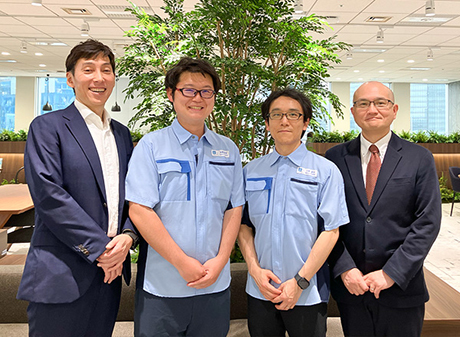
From left in the photo: Kenichi Sakai, Takahiro Kato, Naoya Komae, Koichi Kawahara
Drug Product Research Department, Planning & Packaging Group: Takahiro Kato, Naoya Komae
In this development, we aimed to design a container that achieves both reduced environmental impact and lower shipment costs while prioritizing quality assurance through strict temperature control. While environmental considerations often involve additional costs, we were able to simultaneously achieve cost reductions by fundamentally reviewing the conventional container configuration. Furthermore, by designing specifications that are easy for external partners, including CMOs, to adopt, we aim to expand global utilization.
Drug Product Research Department, Planning & Packaging Group Manager: Kenichi Sakai
The more successful our new drug development becomes, the more shipment volumes increase, making the role of shipment containers increasingly important in terms of both environmental impact and cost. We will continue research and development of shipment methods and contribute to even more efficient reductions in environmental impact through technological innovation.
ESG Promotion Department, Environmental Group Manager: Koichi Kawahara
Environmental issues, including climate change, not only threaten people’s healthy lives but also pose risks that impact corporate business activities themselves. The Chugai Group has established its Mid-Term Environmental Goals 2030, with 2030 as the goal, and is actively working toward them. We believe that initiatives across the entire value chain that both protect pharmaceutical quality and reduce environmental impact will lead to our fundamental management policy of “creating shared value with society.” Through innovative global environmental conservation activities in collaboration with external partners, and proactive information disclosure based on evidence, we aim to become a global role model leading the resolution of environmental issues.