
How an Original Idea Took Shape: The Journey of the Bispecific Antibody Research That Led to the Lasker Award
- Innovation
- R&D


Hemophilia is a condition in which the blood does not clot easily, so that once bleeding starts — after an injury or a bruise, for example — it is difficult to stop. Hemophilia A in particular is caused by a deficiency of Factor VIII, a protein required for blood to coagulate. More than 20 years ago, researchers at Chugai took on a different challenge: “Rather than replacing the deficient factor itself, could its function be substituted with an antibody?” That idea was the starting point of research into a bispecific antibody for hemophilia A. This research has now been recognized with the Lasker Award (the Lasker-DeBakey Clinical Medical Research Award), one of the world’s most prestigious honors in medicine. What kind of research was it? And why was it recognized by a world-renowned medical award? Tracing the story behind its development, we explore its scientific significance together with the words of the three Chugai researchers who received the award: Kunihiro Hattori (former Senior Fellow of Chugai), Takehisa Kitazawa (Deputy Head of Research Division, Chugai) and Tomoyuki Igawa (Head of Research Division, Chugai).
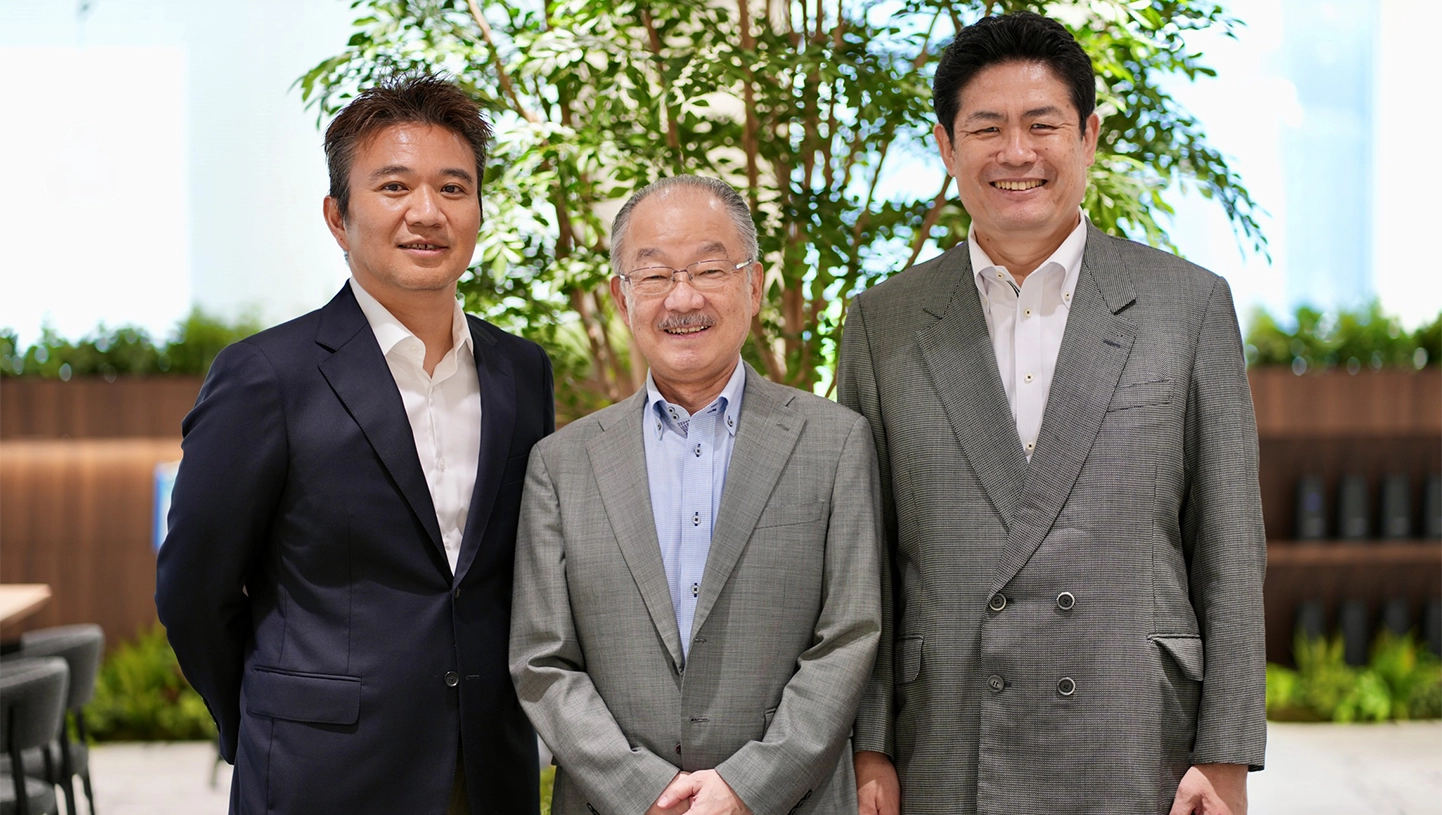
*In the photo, from left: Igawa, Hattori and Kitazawa
This article is intended to introduce the research recognized by a medical research award and the scientific significance of that research. The content explains the historical and academic background of the research and development, and is not intended to recommend, evaluate or provide information about any specific pharmaceutical product or treatment. For decisions regarding treatment, please always consult a healthcare professional.
What is hemophilia A?
People with hemophilia A are born with a deficiency of Factor VIII, the protein needed for blood to clot, and so their blood does not coagulate easily. In our bodies, platelets first gather to stop bleeding, which is known as primary hemostasis, and several blood coagulation factors then work together to form a firm clot, which is known as secondary hemostasis. In hemophilia A, Factor VIII, which is required for this secondary hemostasis, is deficient. As a result, when bleeding occurs after an injury or a bruise, it can take time for the bleeding to stop, and bleeding may recur even once it has stopped. Continuous treatment is needed to prevent bleeding, and people with hemophilia A and their families have lived with treatment over long periods of time.
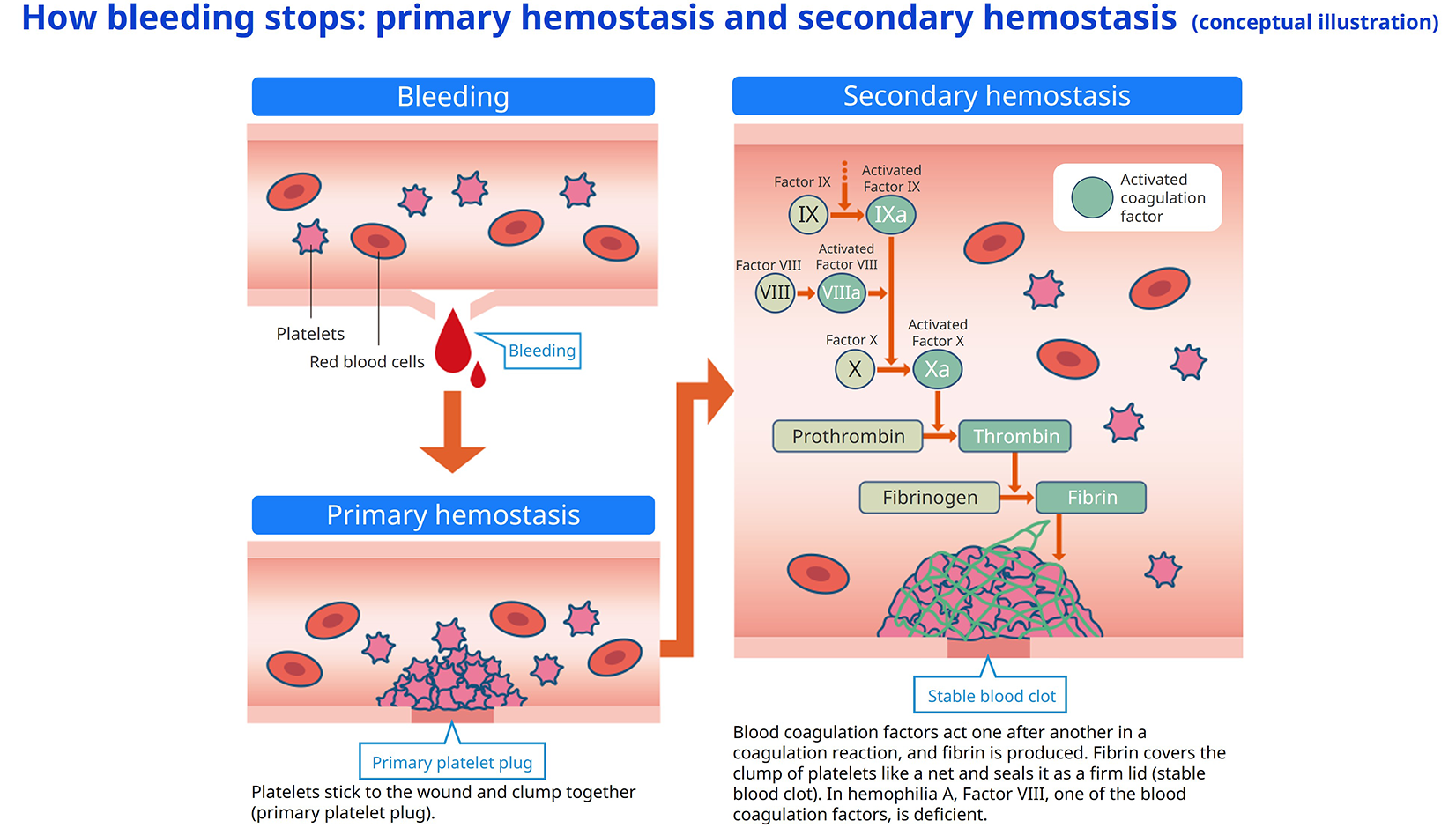
How bleeding stops: primary hemostasis and secondary hemostasis (conceptual illustration). People with hemophilia A are deficient in Factor VIII, one of the blood coagulation factors.
Unconventional thinking: creating an antibody that substitutes the function, instead of replacing the deficient factor
Within the reactions that make blood clot, Factor VIII acts as a kind of “bridge.” It supports and advances the reaction that two separate proteins — activated Factor IX and Factor X — carry out on the surface of activated platelets. In August 2000, Kunihiro Hattori, who was leading antibody drug research at Chugai’s research laboratories, conceived an idea: “Rather than replacing the deficient Factor VIII itself, could its function be substituted with an antibody?” Behind that idea were the challenges faced by people with hemophilia A. The prophylactic therapy that was beginning to become widely available at the time changed the quality of life (QOL) of people with hemophilia A, but it required regular intravenous injections several times a week in order to replace the deficient Factor VIII on a continuous basis. In congenital hemophilia A, Factor VIII is deficient from birth, so administering intravenous injections at home several times a week from infancy was a burden not only for the individual but also for their family. In addition, some people developed antibodies known as “inhibitors” against the replaced Factor VIII, so that it no longer worked sufficiently in the body.
“Could these treatment challenges be solved through a different approach — an antibody?”
An antibody could be administered subcutaneously and could be expected to remain active in the body for a long time. And because it is not Factor VIII itself, there was also a possibility that it would not be affected by the inhibitors that were a challenge at the time. That was how Hattori saw it. At the time, however, the idea of reproducing the function of Factor VIII with an antibody that binds two different targets drew questions such as “Can that really be done?” At the same time, there were also supportive voices: “This is interesting,” and “It is technically difficult, but there may be a way to do it.”
And so the challenge of creating a bispecific antibody for hemophilia A began.
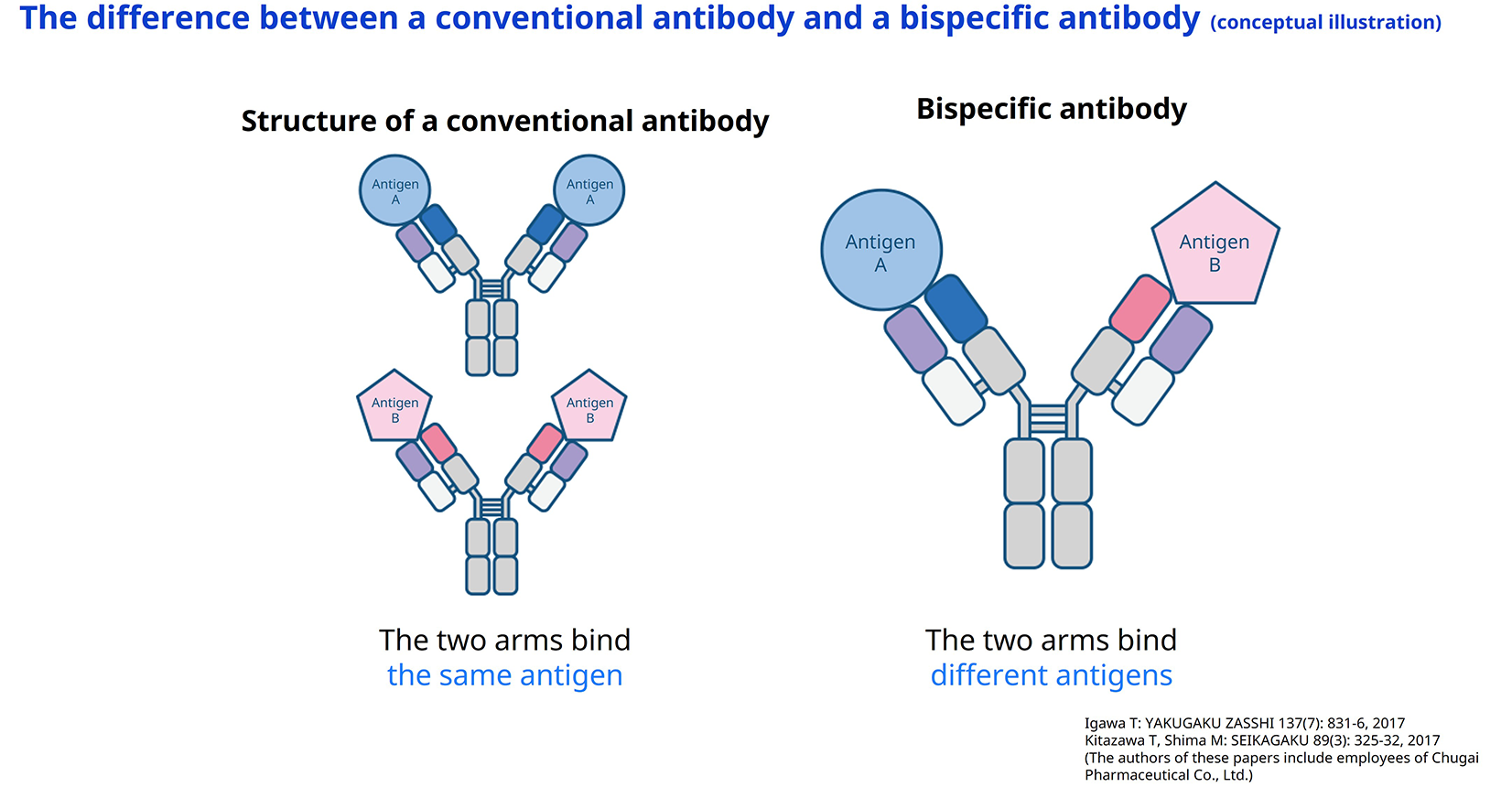
A conventional antibody binds the same antigen with its left and right arms. A bispecific antibody is an antibody that has been engineered so that its left and right arms bind different antigens.
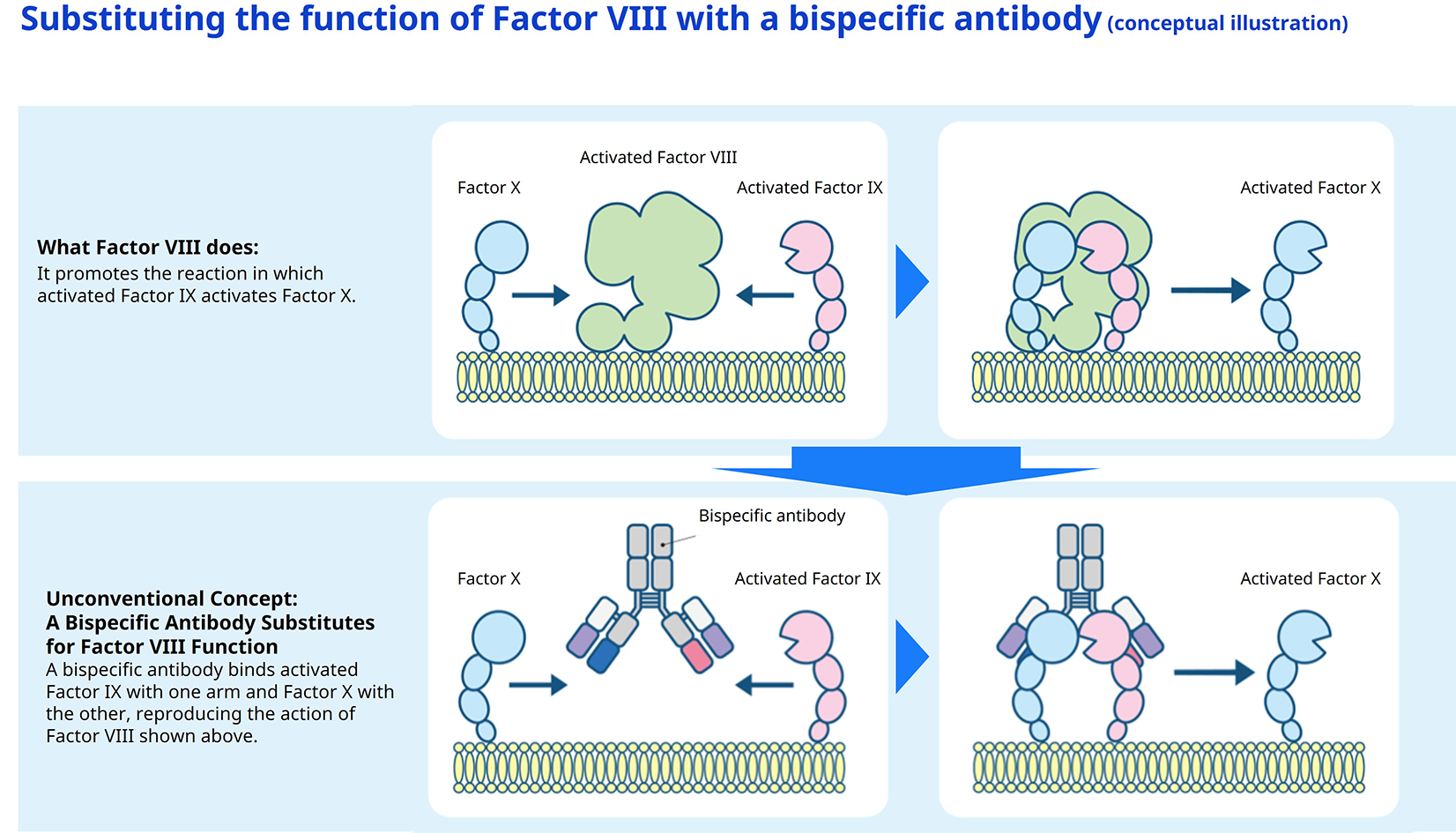
Unconventional Concept: A Bispecific Antibody Substitutes for Factor VIII Function. A bispecific antibody that binds activated Factor IX with one arm and Factor X with the other reproduces the action of Factor VIII.
Why was it so difficult? Could an antibody that joins two proteins be made, and how could the idea be turned into technology?
The team led by Hattori and Takehisa Kitazawa launched the research project in 2002. They first evaluated 460 bispecific antibodies, discovered antibodies that showed activity in vitro (experimental systems using test tubes or cultured cells), and succeeded in demonstrating the drug discovery concept. After that, however, sufficient hemostatic activity and safety in animals could not be obtained, and in 2006 the decision was made to discontinue development. Even so, the researchers did not give up. They proposed taking on the challenge again and received internal approval, albeit with a time limit of one and a half years to obtain a new lead antibody. Reviewing their evaluation methods as they went, the team repeated a process of trial and error and ultimately evaluated approximately 40,000 antibodies. That accumulation led to a breakthrough: right at the deadline, they obtained a lead antibody with the potential to become a medicine. At this stage, the person who took charge of the biology at the heart of this research was Kitazawa, who had engaged with the work out of a strong interest in the complex mechanisms of blood coagulation. In this process, technology development to make the bispecific antibody viable as a medicine also moved forward, centered on the ideas of Tomoyuki Igawa, and Chugai’s proprietary antibody engineering technology, ART-Ig, was born.
In 2008, promising antibodies were beginning to come into view, but many challenges remained: for example, improving activity often impaired stability. Igawa, who came from an engineering background and brought the idea of designing antibodies into the antibody drug discovery, repeatedly designed bispecific antibodies while obtaining a series of evaluation results. He worked on multidimensional optimization that covered not only activity but also pharmacokinetics, safety, formulation stability and ease of manufacturing. After designing and evaluating as many as 2,400 antibodies, the final candidate molecule for the medicine was determined in 2010.
This research was also not something Chugai accomplished on its own. Nara Medical University, with which joint research had been conducted since 2003, has led the clinical care and study of hemophilia over many years, and played an important role in supporting the advancement of the research, including through its expertise in blood coagulation and the construction of evaluation systems.
What did the Lasker Award recognize?
The Lasker Awards are U.S. medical awards that honor researchers who have made major contributions to the advancement of medical research, as well as individuals who have left a notable legacy in the fields of medicine and public health.
The citation for this award sets out, in addition to the original concept of “a bispecific antibody that joins Factor IX and Factor X, restoring the deficient Factor VIII activity in hemophilia A,” that this technology has opened the way to the development of new antibody drugs not only for hemophilia A but also for a variety of diseases, and that it is contributing to reducing the treatment burden for people with hemophilia A and their families.
What made it possible to keep taking on the challenge: messages from the laureates
From what kind of corporate culture did the research that led to the Lasker Award emerge? We asked the three laureates about the research environment that supported their long endeavor and about their feelings toward the people who walked alongside them.
Kunihiro Hattori
“Through my work in research, I saw people with hemophilia and their families living with treatment over long periods of time. What I then thought of was this idea: rather than replacing the deficient Factor VIII itself, could an entirely different molecule — an antibody — substitute the ‘bridging’ role that Factor VIII plays? At the time it was called an outlandish idea, but I never thought the possibility was low. This research was made possible by the efforts of many researchers and healthcare professionals. And even now, there are patients around the world who need treatment but are not yet able to receive its benefits fully. I believe that continuing to confront that challenge is the mission entrusted to us.”
Takehisa Kitazawa
“In high school, I learned about the world of biotechnology, in which a wide variety of proteins are produced from just four bases, and it felt to me like magic. That passion has not changed to this day. When I heard Hattori’s idea, the logic made sense to me immediately, but I felt that turning it into a medicine would be very challenging. At the same time, I was drawn to its originality and a strong curiosity welled up in me. The research had its peaks and valleys; at times we seized good fortune and at times we failed, but from failure we gained new learning. Looking back, I was able to genuinely enjoy it, including the difficult times. I offer my heartfelt thanks to the people with hemophilia A and their families and to the healthcare professionals who supported this research, to my colleagues at Chugai and in the Roche Group who shared both the hard times and the good, and to the doctors at Nara Medical University with whom we carried out joint research.”
Tomoyuki Igawa
“When I was a child, I liked building things with LEGO that were not in the instructions. The fun of creating something new within set constraints carries over into this research as well. To make an antibody with activity work as a medicine, many criteria had to be satisfied at the same time: stability, solubility, ease of manufacturing and more. Challenges appeared one after another; it was like an endless mountain climb. Even so, we kept taking on the challenge together with our colleagues, believing that beyond it lay a view that would lead to new possibilities for patients and their families. What drives us to continue our research is the hope that lies ahead. Hoping that it will lead to a future in which patients and their families can live more freely and more like themselves, I want to keep taking on new challenges.”
Chugai will continue to engage sincerely with the challenges patients face, creating innovation on a continuous basis with the aim of addressing unmet medical needs.
References
Kitazawa T, Igawa T, Hattori K, et al. Nat. Med. 2012;18(10):1570–1574.
Sampei Z, et al. PLoS One. 2013;8(2):e57479.
Shiraiwa H, et al. Methods. 2019;154:10–20.
Related information
Related Stories
-
Breaking Through Drug Discovery's Computational Challenge: Chugai's Path Toward Practical Quantum Computing
Drug discovery is a complicated process of identifying the most promising clinical candidates from an enormous number of molecular combinations. Improving...
- Innovation
- R&D
- DX
-
Building Chugai's Bridge to Global Innovation: Inside the US Partnering Office
Chugai’s U.S. Partnering Office in South San Francisco is expanding the way Chugai Pharmaceutical engages with breakthrough science in the United...
- Innovation
- R&D
- Partnering
-
Transforming Bioprocesses Through the Use of AI: A Challenge Driven by Collaboration Between Data Scientists and Bioprocess Researchers
Bioprocessing is a method of producing active pharmaceutical ingredients for biopharmaceuticals using living cells and microorganisms, and it plays a...
- Innovation
- R&D
- DX