
Jun 30, 2026
- R&D
Launch of Joint Research Using Real-World Data and Generative AI (LLM) to Improve the Accuracy and Efficiency of Identifying Candidate Patients for Clinical Trials
Kindai University School Corporation
Chugai Pharmaceutical Co., Ltd.
TOKYO, June 30, 2026 -- The Department of Medical Oncology at Kindai University Hospital (hereafter “Kindai University Hospital”) and, Chugai Pharmaceutical Co., Ltd. (hereafter “Chugai”) announced today the launch of a four-party joint research project (hereafter “this research”) in June 2026, with support from NTT Inc. (hereafter “NTT”) and NTT DATA. The research aims to verify the accuracy of candidate patient identification for clinical trials and the efficiency of the identification process by leveraging real-world data1 accumulated in clinical practice together with large language models (LLMs2), an AI technology. In this research, the parties will compare and evaluate conventional identification methods and methods that integrate LLMs, using electronic medical record data and other information held by Kindai University Hospital, based on the eligibility criteria4 set forth in the clinical trial protocol3 prepared by Chugai. Taking the assessment results of physicians and clinical research coordinators (CRCs5) as the benchmark for comparison, the parties will conduct a multifaceted verification of the effectiveness in actual operations, the reduction of workload, and contributions to shortening the lead time until the enrollment of clinical trial participants.
[Background]
In the clinical development of new drugs, trial initiation timelines and participant enrollment periods have a significant impact on the timing of market launch6. The identification of candidate patients, in particular, has long been a labor-intensive and time-consuming process, requiring physicians and CRCs to individually review medical records against the eligibility criteria defined in the clinical trial protocol. Delays in patient enrollment have therefore been recognized as a key factor that can affect overall trial timelines.
In recent years, as the utilization of real-world data generated in clinical practice continues to expand, LLMs are gaining attention for their ability to comprehensively interpret patient information, including unstructured data. Harnessing these technologies is expected to enhance the accuracy of candidate patient identification and streamline the overall identification process in clinical trials.
[Overview of This Research]
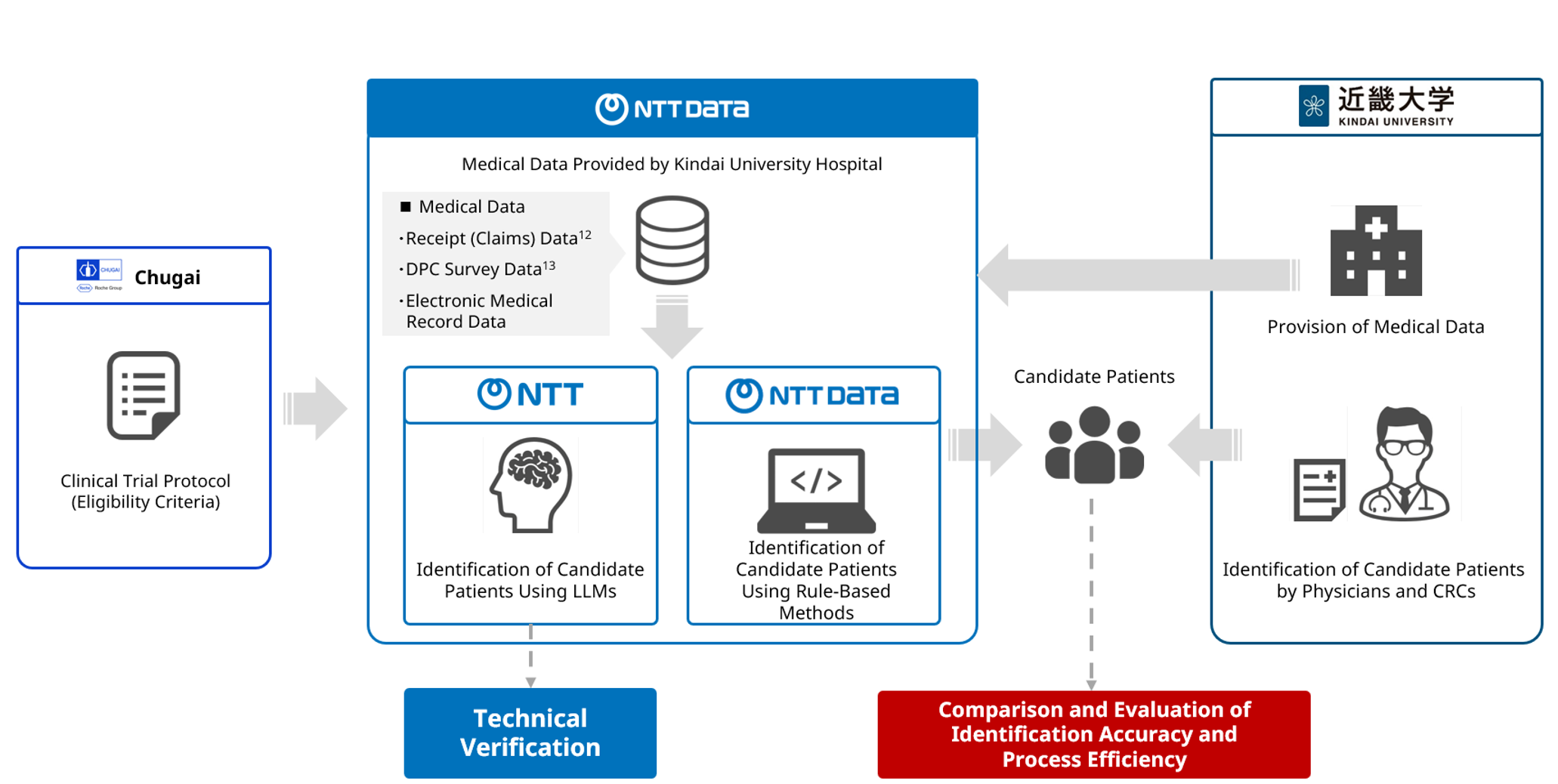
In this research, the parties will leverage electronic medical record data and other information held by Kindai University Hospital to identify candidate patients for clinical trials using LLMs, based on the eligibility criteria defined in the clinical trial protocol prepared by Chugai. NTT DATA will conduct the technical verification of candidate patient identification using both LLMs and rule-based methods8, drawing on its expertise in the utilization and analysis of medical data, as well as its proven track record in secure information management and data operation design - cultivated through the operation of its medical information platform, “Millennium Medical Record”7. The technical verification will employ “tsuzumi 2” 9, a fully Japan-made large language model independently developed by NTT. Built around a design that prioritizes data governance, tsuzumi 2 is engineered to support operations involving data that may contain sensitive information. The verification is also planned to be conducted with a healthcare-specific version of tsuzumi 2, which has undergone continuous pre-training on published medical literature and other relevant sources.
The following three identification approaches will be evaluated: (1) a rule-based method using Python10 and SQL11; (2) an LLM-based method; and (3) a combination of the two. The results of each approach will be compared against the assessments made by physicians and CRCs to evaluate the accuracy of candidate patient identification. The parties will also examine the time required for identification, along with any changes in the workload and tasks of physicians and CRCs. Through this verification, the research will assess whether improvements in both the accuracy of candidate patient identification and the efficiency of the identification process can contribute to shortening the lead time to clinical trial enrollment.
This research has been approved by the Research Ethics Committee of Kindai University Faculty of Medicine and is scheduled to run through March 2027.
[Significance of This Research]
This research aims to quantitatively verify whether improvements in the accuracy of candidate patient identification and the efficiency of the identification process - achieved through the use of LLMs - can contribute to shortening the lead time to clinical trial enrollment. The findings are expected to help shorten overall trial timelines, accelerate drug development at pharmaceutical companies, and streamline clinical trial operations at medical institutions, while also fostering an environment in which patients can gain faster access to new treatment options. It should be noted that the outputs generated by AI are intended to support physicians’ decision-making, and final clinical decisions will always be made by physicians.
[Roles of Each Organization]
- Kindai University Hospital: Provision of medical data; identification of candidate patients for clinical trials; and comparison and evaluation of identification accuracy and process efficiency.
- Chugai Pharmaceutical: Provision of the clinical trial protocol (eligibility criteria) and collaboration in the evaluation.
- NTT: Implementation of the technical verification14 of candidate patient identification using LLMs.
- NTT DATA: Implementation of rule-based candidate patient identification, and comparison and evaluation of identification accuracy and process efficiency.
This research builds upon the insights gained from the technical verification15 announced by Kindai University Hospital and NTT DATA in May 2026. Specifically, it evaluates the effectiveness of candidate patient identification and its applicability to real-world operations by leveraging real-world data under the eligibility criteria defined in clinical trial protocols for trials currently enrolling participants.
Based on the outcomes of this research, the participating organizations will further explore the potential for the real-world deployment of a candidate patient identification platform that harnesses real-world data and AI, through further collaboration with medical institutions and pharmaceutical companies.
Sources:
- Real-World Data: Medical data accumulated from actual clinical practice, increasingly utilized in clinical trials, new drug development, and the improvement of healthcare quality.
- Large Language Model (LLM): An artificial intelligence technology that learns from vast amounts of text data, enabling the understanding and generation of natural language. It is widely used in the field of natural language processing.
- Clinical Trial Protocol: A document that specifies in advance the objectives, methods, and participation criteria of a clinical trial conducted to investigate the efficacy and safety of investigational drugs.
- Eligibility Criteria: Conditions - based on factors such as age and medical condition - that define who is eligible to participate in a clinical trial, established to ensure the trial’s safety and scientific reliability.
- Clinical Research Coordinator (CRC): A healthcare professional who coordinates among physicians, trial participants, pharmaceutical companies, and other stakeholders, supporting the appropriate conduct of clinical trials.
- Market Launch: The point at which a new drug commercially available for clinical use after regulatory approval.
- Millennium Medical Record: The name of a project conducted by the Life Data Initiative and NTT DATA Japan Corporation under government certification, based on the “Act on Anonymously Processed Medical Information and Pseudonymously Processed Medical Information to Contribute to Research and Development in the Medical Field” (Next-Generation Medical Infrastructure Act).
- Rule-Based Method: A method for identifying candidate patients for clinical trials by programming, in advance, the conditions defined in the clinical trial protocol.
- tsuzumi 2: A large language model developed by NTT, Inc., capable of processing a wide range of languages, including Japanese.
- Python: A programming language widely used for data analysis, system development, and various other applications.
- SQL (Structured Query Language): A language for operating databases, used for extracting and aggregating data based on specified conditions.
- Receipt (Claims) Data: Data prepared by medical institutions to claim medical service fees, containing information such as treatment details and prescribed medications.
- DPC Survey Data: Data that organizes diagnoses and treatment details in inpatient care, providing information for understanding patient conditions and the overview of treatment.
- Technical Verification of Candidate Patient Identification Using LLMs: The verification will be conducted using technology developed by NTT Computer and Data Science Laboratories.
- Technical Verification Announced by Kindai University Hospital and NTT DATA in May 2026: An initiative in which a technical verification of candidate patient identification leveraging real-world data was conducted to evaluate its effectiveness.
https://www.nttdata.com/global/ja/news/topics/2026/052500/
- “tsuzumi” is a registered trademark of NTT, Inc.
* Other product names, company names, and organization names mentioned herein are trademarks or registered trademarks of their respective owners.
[Inquiries Regarding This Matter]
Kindai University School Corporation
Headquarters for the Faculty of Medicine, Faculty of Nursing, and Hospital Administration
General Affairs and Public Relations Division
Contact: Morii, Hashimoto
TEL: +81-72-288-7222 FAX: +81-72-298-1500
E-mail: med.koho@itp.kindai.ac.jp
Chugai Pharmaceutical Co., Ltd.
For Media Inquiries
Media Relations Group, Corporate Communications Dept.
Tel: +81-3-3273-0881
E-mail: pr@chugai-pharm.co.jp
For Investor Inquiries
Investor Relations Group, Corporate Communications Dept.
Tel: +81-3-3273-0554
E-mail: ir@chugai-pharm.co.jp